
How to Ask Questions in Spanish
One of the biggest surprises for many Spanish learners is how simple it is to form questions in Spanish. If you are coming from English, you might expect complicated grammar rules, changes in word order, or special helping verbs.
The truth is much better.
In Spanish, asking questions is often much easier than in English. In many cases, you do not need to change the structure of the sentence at all. Instead, you rely mainly on intonation and punctuation.
In this blog post, I will walk you through how Spanish questions really work, why they are simpler than English questions, and what you need to pay attention to when speaking.
Why Questions in Spanish Are Easier Than in English
In English, forming a question usually requires changing the structure of a sentence. For example:
You speak Spanish.
Do you speak Spanish?
Here we need to add the word “do” and change the order of the words.
Spanish works differently.
Most of the time, the sentence structure stays exactly the same whether you are making a statement or asking a question. The difference comes from your tone and the punctuation.
This is one of the reasons many learners find Spanish questions refreshing once they understand the rule.
The Importance of Intonation
The most important concept when asking questions in Spanish is intonation.
When you ask a question, your voice rises slightly at the end of the sentence. That rising tone signals to the listener that you are asking something rather than making a statement.
Let’s look at an example.
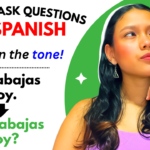
Statement:
Tú hablas español.
You speak Spanish.
Question:
¿Tú hablas español?
Do you speak Spanish?
Notice something important here. The structure of the sentence did not change at all. The subject, verb, and object remain the same.
The only differences are:
- Your voice rises at the end
- The sentence uses question marks
Because of this, pronunciation and tone become very important when speaking Spanish naturally.
Spanish Uses Two Question Marks
Another unique feature of Spanish is the use of two question marks.
English only uses one question mark at the end of the sentence:
Do you speak Spanish?
Spanish uses both an opening and a closing question mark:
¿Hablas español?
The opening question mark tells the reader from the beginning that the sentence is a question. This helps guide the correct intonation while reading.
Without it, the reader would not know it is a question until reaching the end.
So whenever you write a question in Spanish, remember to include both:
¿ at the beginning
? at the end
This is an essential part of correct Spanish punctuation.
The Basic Sentence Structure in Spanish
To fully understand Spanish questions, it helps to know the most common sentence structure.
Spanish typically follows this order:
Subject + Verb + Complement
Let’s look at a few examples.
Tú comes en casa.
You eat at home.
Nosotros vivimos aquí.
We live here.
Ella estudia español.
She studies Spanish.
This structure is extremely common in Spanish. The good news is that it usually stays the same when turning the sentence into a question.
For example:
¿Tú comes en casa?
Do you eat at home?
¿Nosotros vivimos aquí?
Do we live here?
¿Ella estudia español?
Does she study Spanish?
Notice again that the order of the words remains exactly the same. The only difference is the question marks and the rising tone when speaking.
Spanish Often Drops the Subject
Another important characteristic of Spanish is that the subject pronoun is frequently omitted.
In English, we almost always include the subject:
Do you live here?
Spanish often leaves it out because the verb conjugation already tells us who the subject is.
For example:
¿Comes en casa?
Do you eat at home?
¿Vives aquí?
Do you live here?
¿Trabajas hoy?
Do you work today?
Even though the pronoun “tú” is not present, the verb forms come, vives, and trabajas clearly indicate that we are talking about “you”.
This is why verb conjugation is such an important part of learning Spanish. Once you understand how verbs change, forming questions becomes very natural.
Questions with Different Verb Types
Spanish verbs generally fall into three main groups depending on their endings:
- Verbs ending in -AR
- Verbs ending in -ER
- Verbs ending in -IR
The good news is that forming questions works the same way with all of them.
-AR Verbs
Example:
¿Tú trabajas hoy?
Do you work today?
The verb trabajar ends in -AR, and its conjugation does not change when forming the question.
-ER Verbs
Example:
¿Tú comes en casa?
Do you eat at home?
Again, the structure remains exactly the same.
-IR Verbs
Example:
¿Tú vives aquí?
Do you live here?
The only change is the intonation and the punctuation.
No additional helping verbs are needed.
Turning Statements Into Questions
Because the sentence structure stays the same, converting a statement into a question in Spanish is very simple.
All you need to do is change the tone and add question marks.
Let’s look at a few examples.
Statement:
Tú trabajas hoy.
You work today.
Question:
¿Tú trabajas hoy?
Statement:
Ellos comen en casa.
They eat at home.
Question:
¿Ellos comen en casa?
Statement:
Nosotros vivimos aquí.
We live here.
Question:
¿Nosotros vivimos aquí?
The grammar does not change. The verb conjugation does not change. The word order does not change.
Only the tone changes.
The Key to Mastering Spanish Questions
If there is one thing to remember about Spanish questions, it is this:
Intonation is everything.
Once you understand the structure of Spanish sentences and how verbs are conjugated, asking questions becomes very straightforward.
With practice, your ear will naturally recognize the rising tone used in questions, and your speech will start to sound more natural.
Like many aspects of language learning, repetition helps a lot. The more you hear and repeat Spanish questions, the more comfortable you will become with the rhythm and melody of the language.
Final Thoughts
Learning how to ask questions in Spanish is one of the most encouraging milestones for beginners. Unlike English, you usually do not need to rearrange the sentence or add extra words.
Instead, you simply keep the same structure, adjust your intonation, and add the correct question marks.
Once you combine this with solid verb conjugation, you will be able to ask questions naturally in everyday conversations.
And that is when Spanish really starts to come alive.